

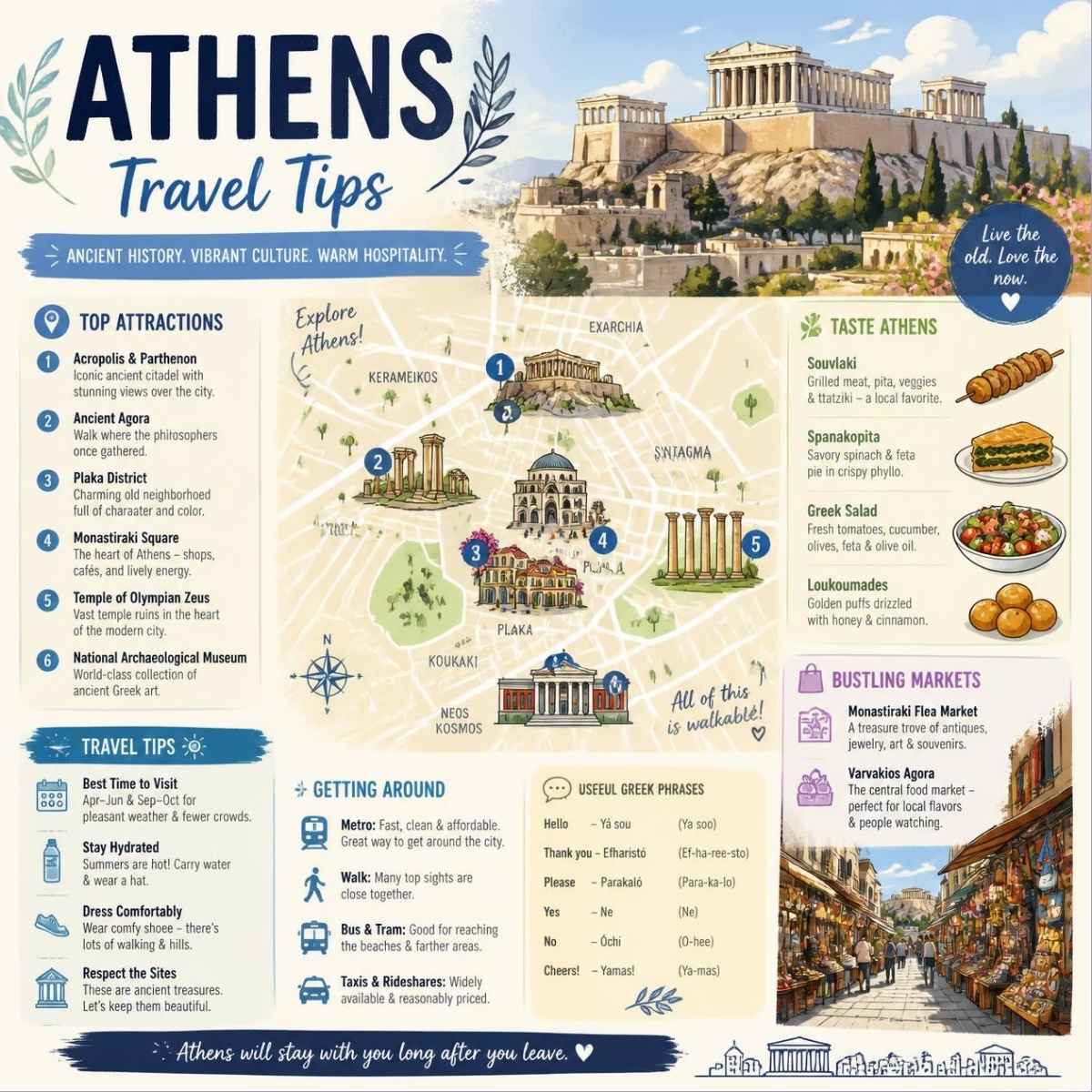
Athens Travel Tips: What you Need to Know Before You Go
Opinions, reviews, analyses & recommendations are the author’s alone, and have not been reviewed, endorsed or approved by any of these entities. This post may contain affiliate links, meaning I get a commission if you decide to make a purchase through my links, at no cost to you. As an Amazon Associate I earn from qualifying purchases.
Athens is one of those destinations that manages to feel both ancient and completely modern at the same time. One minute, you’re walking through the ruins of the Acropolis, surrounded by thousands of years of history; the next, you’re sitting at a rooftop restaurant eating dinner while scooters zip through the streets below.
For first-time visitors, Athens can also feel a little overwhelming. The city is large, busy, hot in the summer, and full of neighborhoods that each have their own personality. Knowing a few practical Athens travel tips before you arrive can make your trip much easier—and help you spend less time worrying about logistics and more time enjoying Greece.
Whether you’re visiting Athens for a long weekend, starting a Greek island vacation here, or spending a few days before heading to Santorini or Crete, these are the things I wish every first-time visitor knew before going.
1. Athens Is Bigger Than You Might Expect
One of the biggest surprises for first-time visitors is just how large Athens is.
When you picture Athens, you may imagine the Acropolis, Plaka, and a few charming streets clustered around the ancient ruins. Those areas are certainly there, but Athens is a sprawling metropolitan area with millions of people.
The good news? You probably won’t need to explore the entire city.
For most first-time visitors, the historic center is where you’ll want to spend the majority of your sightseeing time. Areas such as Plaka, Monastiraki, Syntagma, Koukaki, and Psyrri put you close to many of the city’s major attractions.
This is one reason choosing the right hotel location matters so much.
If your primary goal is sightseeing, staying somewhere within walking distance of the Acropolis and historic center can save you a surprising amount of time. Athens does have an extensive public transportation system, but being able to walk back to your hotel after a long day of sightseeing is incredibly convenient.
2. You Will Do a LOT of Walking
Bring comfortable shoes.
Seriously.
Athens is a walking city, especially if you’re planning to visit the Acropolis, Ancient Agora, Roman Agora, Plaka, Monastiraki, and other historic sites.
And this isn’t necessarily the kind of walking you’ll do on perfectly flat sidewalks.
You’ll encounter uneven ancient stones, stairs, hills, cobblestones, and slippery marble. The Acropolis itself requires walking uphill, and some areas around the archaeological sites can be challenging in the heat.
Cute shoes that you can only tolerate for an hour are probably not going to make the cut.
Instead, bring comfortable walking shoes with good traction. Sneakers or supportive walking sandals are usually much better choices.
You’ll also want to break in your shoes before your trip. Athens is not the place to discover that your brand-new sandals give you blisters.
3. Summer in Athens Is HOT
If you’re visiting Athens during July or August, prepare for serious heat.
Temperatures can climb well into the 90s°F, and the combination of intense sun, stone surfaces, and lots of walking can make sightseeing feel even hotter.
This is especially important when visiting the Acropolis.
There isn’t much shade at the top of the Acropolis, so timing your visit can make a huge difference.
If possible, schedule major outdoor sightseeing early in the morning or later in the afternoon. You’ll not only avoid some of the worst heat, but you’ll often have a more enjoyable experience overall.
Bring:
- A refillable water bottle
- Sunscreen
- Sunglasses
- A hat
- Comfortable shoes
- Lightweight clothing
- A small bag
- A portable fan if you tend to get overheated
And don’t underestimate how much water you’ll need.
There are places to purchase water throughout Athens, but having water with you when you’re climbing toward the Acropolis is especially helpful.
4. Book the Acropolis in Advance
If there is one attraction you absolutely should plan ahead for, it’s the Acropolis.
The Acropolis is Athens’ most famous attraction and one of the most recognizable archaeological sites in the world. It is also extremely popular.
During peak travel season, tickets and desirable entry times can sell out.
Don’t assume you’ll be able to wake up that morning and simply walk up to buy a ticket at the time you want.
If visiting the Acropolis is important to you, reserve your admission ahead of time through the official ticketing system or an established tour company.
Pay particular attention to your entry time. Your ticket isn’t simply a suggestion about when to arrive—it can determine when you’re allowed to enter.
Also remember that visiting the Acropolis is only part of experiencing ancient Athens. The Acropolis Museum, Ancient Agora, Roman Agora, and other archaeological sites are worth adding if you have enough time.
5. The Acropolis Museum Is Worth Your Time
Even if museums aren’t normally your thing, consider visiting the Acropolis Museum.
The museum provides context for what you’re seeing on the Acropolis itself. After walking among ancient ruins, being able to see artifacts and learn more about the people, architecture, and history behind them makes the experience much more meaningful.
Another advantage?
The museum provides a break from the heat.
A good strategy is to visit the Acropolis earlier in the day and then spend some time at the museum afterward.
That gives you a chance to cool down while continuing your exploration of ancient Athens.
6. You Don’t Need a Car in Central Athens
Renting a car for your entire Athens stay usually isn’t necessary.
Traffic can be frustrating, parking can be difficult, and many of the most popular tourist areas are much easier to explore on foot.
Athens has a metro, buses, trams, taxis, and rideshare-style transportation options that make getting around without a rental car relatively easy.
The metro can be particularly useful for airport transportation and getting between major parts of the city.
If you’re planning to rent a car later for a road trip through Greece or on an island such as Crete, consider waiting until you leave Athens.
You’ll save yourself the hassle of navigating city traffic and searching for parking.
7. The Athens Airport Is Outside the City Center
Athens International Airport is located quite a distance from central Athens.
That means your airport transfer can take some time, particularly if you’re arriving during busy traffic periods.
You have several transportation options, including the metro, suburban railway, airport buses, taxis, and private transfers.
The best option depends on your budget, luggage, arrival time, and hotel location.
If you’ve just arrived after a long international flight, a private transfer can be especially appealing. You don’t have to figure out public transportation while exhausted and carrying luggage.
If you’re traveling on a budget, public transportation can be a much more economical option.
8. Athens Uses the Euro
Greece uses the euro (€), so you’ll want to have some euros available during your trip.
Credit and debit cards are widely accepted at hotels, restaurants, stores, attractions, and many other businesses. You shouldn’t need to carry large amounts of cash.
Still, having some cash is a good idea.
Smaller businesses, kiosks, markets, or certain purchases may be easier with cash, and having a few euros available means you aren’t stuck if a card terminal isn’t working.
Avoid exchanging large amounts of money at the airport unless absolutely necessary, as airport exchange rates aren’t always the most favorable.
A travel-friendly debit card with low or no foreign transaction fees can also save you money.
9. Tipping in Athens Is Different From the U.S.
One of the biggest cultural differences American travelers may notice is tipping.
You generally aren’t expected to tip at the same level you might in the United States.
At restaurants, rounding up the bill or leaving a small amount for good service is common. In tourist-oriented restaurants, you may see a service charge included, so check your bill before adding anything extra.
For taxis, rounding up is generally sufficient.
The important thing is not to feel pressured into tipping 20%, 25%, or more simply because that’s what you’re accustomed to at home.
Tipping practices can vary, but you should feel comfortable following local norms rather than American tipping culture.
10. Learn a Few Greek Words
You don’t need to become fluent in Greek before your vacation.
Most people working in tourism speak at least some English, particularly in hotels, restaurants, and popular tourist areas.
However, learning a few basic Greek words is fun and appreciated.
Try:
Yassas – Hello
Efharistó – Thank you
Parakaló – Please / You’re welcome
Nai – Yes
Óchi – No
Even making a small effort can make interactions feel more personal.
And don’t worry if your pronunciation isn’t perfect. Most Greeks will appreciate that you’re trying.
11. Athens Is a Late-Night City
Don’t be surprised if dinner at 6:00 p.m. feels unusually early.
Athens has a very social, late-night culture. Locals often eat dinner much later than Americans are accustomed to, and restaurants may stay busy well into the evening.
This can actually be wonderful for travelers.
You can spend the afternoon sightseeing, return to your hotel to shower and relax, and then head out for dinner when the city starts coming alive.
Rooftop restaurants and bars are particularly popular because of the incredible views of the illuminated Acropolis.
If you want a specific restaurant, especially during high season, make a reservation.
12. Plaka Is Charming—but Don’t Spend Your Entire Trip There
Plaka is one of Athens’ most famous neighborhoods, and for good reason.
Its narrow streets, colorful buildings, restaurants, shops, and proximity to the Acropolis make it an easy place to fall in love with.
But Athens is much more than Plaka.
Consider exploring neighborhoods such as:
Monastiraki: Great for shopping, food, markets, and Acropolis views.
Psyrri: Known for restaurants, bars, street art, and nightlife.
Koukaki: A popular neighborhood close to the Acropolis with restaurants and a more local feel.
Syntagma: Convenient for transportation and close to major attractions.
Exploring beyond the most touristy streets can give you a better sense of everyday Athens.
13. Be Prepared for Graffiti
Athens has a lot of graffiti and street art.
Depending on where you’re staying, you may notice graffiti covering walls, storefronts, and abandoned buildings.
Some visitors find it surprising because it contrasts so dramatically with the ancient ruins and historic architecture.
But Athens has a significant street-art culture, and some areas have incredible murals and elaborate artwork.
Don’t assume every piece of graffiti is vandalism. Take some time to look at the street art—you may be surprised by what you find.
14. Watch Your Belongings in Crowded Areas
Athens is generally a welcoming destination, but like any major tourist city, you should use normal precautions.
Keep an eye on your belongings in crowded places, particularly around busy metro stations, markets, and tourist attractions.
A crossbody bag worn securely across your body is a good choice.
Avoid putting your phone or wallet in an easily accessible back pocket, and don’t leave valuables unattended at restaurants or cafes.
You don’t need to be paranoid. Just use the same awareness you’d use in any large city.
15. Don’t Try to See Everything in One Day
This is probably one of the most important Athens travel tips.
It’s tempting to try to squeeze everything into a single day if Athens is simply your starting point for a Greek island vacation.
But Athens deserves more than a rushed checklist.
If you only have one day, prioritize the Acropolis, Acropolis Museum, Plaka, Monastiraki, and a good Greek meal.
With two days, you can slow down and add Ancient Agora, Syntagma Square, Psyrri, or another neighborhood.
With three days, you have enough time to explore more comfortably and possibly add an excursion or day trip.
The goal isn’t to collect attractions. It’s to actually enjoy the city.
16. Give Yourself Time to Adjust After a Long Flight
If you’re flying from the United States, don’t underestimate jet lag.
You may arrive in Athens exhausted but too excited to sleep.
Rather than immediately trying to conquer every attraction, give yourself some time to adjust.
A relaxed first afternoon can be perfect.
Check into your hotel, take a shower, grab a coffee, walk around your neighborhood, enjoy a Greek dinner, and get to bed at a reasonable local time.
You’ll likely enjoy the rest of your trip much more if you aren’t trying to climb the Acropolis while running on three hours of sleep.
17. Greek Food Is More Than Gyros
Yes, you should absolutely eat gyros.
But don’t stop there.
Greek cuisine is incredibly diverse, and Athens is a fantastic place to try traditional dishes.
Look for:
- Moussaka
- Souvlaki
- Greek salad
- Spanakopita
- Tzatziki
- Dolmades
- Pastitsio
- Grilled meats
- Fresh bread and dips
- Baklava
- Greek yogurt with honey
One of the best ways to experience Athens is to choose a restaurant away from the busiest tourist streets and order several dishes to share.
And don’t be afraid to ask your server what they recommend.
18. Water Is Safe to Drink
Tap water in Athens is generally safe to drink.
Bringing a reusable water bottle is a great way to stay hydrated while reducing the number of plastic bottles you purchase.
If you’re particularly sensitive to the taste of local water, bottled water is readily available.
During the summer, however, the important thing is simply to drink enough.
Between the heat and all the walking, dehydration can sneak up on you quickly.
19. Public Restrooms May Not Be What You’re Used To
Here’s a practical Athens travel tip that isn’t always mentioned in travel guides.
In many places in Greece, you’re asked not to flush toilet paper down the toilet. Instead, you’ll find a small waste bin beside the toilet.
This is because the plumbing systems in many older buildings aren’t designed to handle toilet paper the same way modern American plumbing does.
Follow the signs or instructions where provided.
It may feel strange at first, but you’ll quickly get used to it.
20. Athens Is a Great Starting Point for a Greek Island Trip
One of the best things about Athens is how easy it is to combine the city with a Greek island vacation.
Many travelers fly into Athens and then continue on to destinations such as Santorini, Mykonos, Crete, Naxos, Paros, or other islands.
If you’re connecting to a ferry, pay close attention to which port your ferry leaves from.
Piraeus is the largest and most commonly used port, but it’s not the only option.
Build in extra time for transportation, especially during the busy summer season.
Ferry schedules can also change because of weather, so don’t plan an impossibly tight connection between your flight and ferry.
21. Don’t Forget Travel Insurance
Travel insurance isn’t exciting, but it can be incredibly valuable.
For an international trip involving flights, hotels, ferries, tours, rental cars, and multiple destinations, there are plenty of things that can go wrong.
Depending on the policy, travel insurance may help with covered trip cancellations, interruptions, delays, lost baggage, or medical emergencies.
Before purchasing a policy, read the actual coverage rather than assuming everything is included.
22. Pack for Both Sightseeing and Going Out
Athens is casual, but you may want something a little nicer for rooftop dinners or evening drinks.
A practical Athens packing strategy is to bring lightweight clothing for daytime sightseeing and one or two outfits that can transition into the evening.
Don’t forget:
- Comfortable walking shoes
- Sandals
- Lightweight clothing
- Sunscreen
- Sunglasses
- Hat
- Reusable water bottle
- Portable charger
- Small crossbody bag
- Light jacket or layer
- Swimsuit if your hotel has a pool
If you’re continuing to the Greek islands, lightweight and versatile clothing becomes even more important.
23. Check Attraction Hours Before You Go
Greek attraction hours can vary by season, and archaeological sites may operate different schedules depending on the time of year.
Always check the current official information before planning your day.
This is particularly important if you have a limited amount of time in Athens.
You don’t want to arrive at an attraction expecting to spend the afternoon there only to discover that it closes earlier than expected.
24. Athens Rewards Slow Travel
The biggest mistake you can make in Athens is treating the city like a checklist.
Yes, see the Acropolis.
Yes, visit the ancient ruins.
Yes, explore Plaka and Monastiraki.
But also sit at a cafe.
Watch people in a busy square.
Stop for a pastry.
Enjoy a long Greek lunch.
Walk down a street simply because it looks interesting.
Stay out for a rooftop drink and watch the Acropolis light up at night.
Some of your favorite Athens memories may have nothing to do with checking an attraction off your itinerary.
Final Athens Travel Tips for First-Time Visitors
Athens can be hot, busy, noisy, historic, modern, chaotic, beautiful, and incredibly fun—all at the same time.
The best way to prepare is to plan the important things in advance without overplanning every minute of your trip.
Book major attractions such as the Acropolis ahead of time, choose a convenient hotel location, wear comfortable shoes, drink plenty of water, carry some euros, and give yourself enough time to actually enjoy the city.
Most importantly, don’t worry about doing Athens “perfectly.”
Explore the ancient ruins. Eat the Greek food. Get lost in the little streets. Watch the sunset. Sit at a cafe. Take a million pictures of the Acropolis.
And if Athens is just the beginning of your Greek adventure, don’t rush through it so quickly that you forget to enjoy the place where your journey began.
Athens isn’t just a stop on the way to the Greek islands. It’s a destination worth experiencing on its own.
Athens Travel FAQ
How many days do you need in Athens?
Two to three days is a great amount of time for a first visit to Athens. One day is enough to see the major highlights, but two or three days allow you to explore at a much more relaxed pace.
What should I wear in Athens?
Comfortable, lightweight clothing and supportive walking shoes are ideal. If you’re visiting churches or religious sites, bring clothing that provides appropriate coverage.
Is Athens safe for tourists?
Athens is generally safe for visitors, but travelers should use normal precautions in crowded tourist areas and on public transportation. Keep your valuables secure and be aware of your surroundings.
Do you need a car in Athens?
No. Most first-time visitors can comfortably explore central Athens using walking, public transportation, taxis, and private transfers. A rental car is generally more useful if you’re leaving Athens for a road trip.
What is the best time to visit Athens?
Spring and fall generally offer pleasant temperatures and fewer crowds than the peak summer months. Summer can be very hot but is also a popular time to combine Athens with a Greek island vacation.
Is Athens expensive?
Athens can accommodate a range of budgets. You can find affordable Greek restaurants and accommodations, while luxury hotels, rooftop restaurants, private tours, and premium experiences can make a trip considerably more expensive.
Can you drink tap water in Athens?
Yes, Athens tap water is generally safe to drink. A reusable water bottle is useful, especially during hot weather.
Do people speak English in Athens?
English is widely spoken in tourist areas, hotels, restaurants, and attractions. Learning a few Greek phrases is still a fun way to connect with locals.
What should you know before visiting the Acropolis?
Wear comfortable shoes, bring water and sun protection, book your admission in advance when possible, and plan your visit around the heat. The site involves walking uphill and over uneven surfaces.
What should you know before traveling to Athens?
The biggest things to know are that Athens involves a lot of walking, summer temperatures can be intense, major attractions should be planned ahead, and you don’t need a rental car to explore the city. Give yourself enough time to slow down and enjoy the city rather than trying to see everything in one day.